
News

Study: Human-centric data economy needs stronger cooperation within and across sectors

One of the main principles of the Estonian digital society is human-centricity. This means that public and private services are designed based on people’s interests and people have a practical opportunity to use their data safely, transparently and in their own interests. TalTech’s study, conducted in cooperation with the Ministry of Justice and Digital Affairs, analysed Estonia’s current status in realising it’s vision for human-centricity and the steps needed for developing a human-centric data economy.

The research project, that sprang from the Idea Contest from the Ministry of Economic Affairs and Communications in 2024, focused on the concept of a personal data space, which aim is to give people a better overview of the data collected about them and the opportunity to decide who uses them, for what purpose and under which conditions. Focusing on domains of finance and education and labour market, it analysed how a personal data space could support people’s interests and decisions, and promote the development of innovative data-based services and business models. It also mapped the needs, motivations and feasibility of companies to implement such solutions.
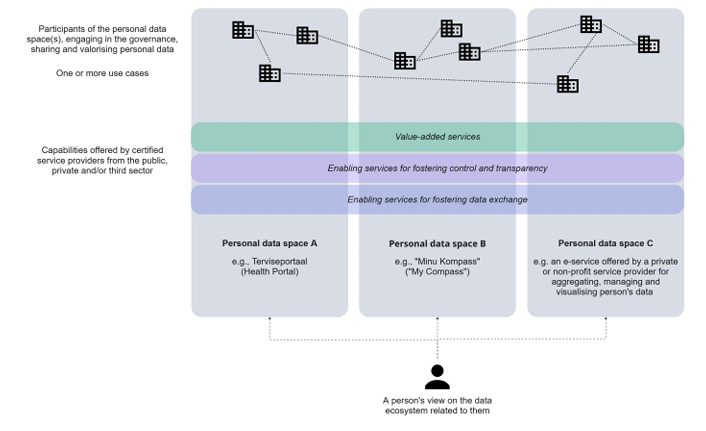

What is a personal data space?

A personal data space does not refer to any specific technical solution, but rather a flexible framework for data-driven collaboration based on interoperability and clear legal and administrative agreements. For an individual, this could mean using a specific digital service to aggregate their data into a single view and decide on its use across different services.

For example, an individual could share their education, work and skills related data in a machine-readable format to receive more accurate advice for developing their skills or get personalised recruitment services. Similarly, they could grant temporary access to their data in other domains, such as healthcare or insurance, allowing them to receive offers for more convenient and personalised services. In such a model, individuals are not just data subjects, but have a role to play as active participants who can direct the use of their data and benefit from the value created by it.

The current state and next steps

According to the study, the Estonian data ecosystem is technologically advanced, but human-centric data use has not yet been fully realised. Despite practical uses of the data tracker or data consent services, people’s opportunities to control the use of their data, share it between different private services and create value from it are still limited. Results show that the development of a human-centric data economy is limited primarily by insufficient business incentives, unclear rights and responsibilities for sharing data, and limited access to high-quality and standardised data.

Companies are interested in developing personalised services, but the readyness to invest is hindered by the uncertainty of consent-based data use, regulatory and administrative ambiguity, and the inertia of existing business models. Reliable data sharing also requires technical and organisational investments, of which returns are not always clear. For such solutions to work, there is a strong need for coordination within and across sectors, sufficient data quality and interoperability, agreements on the rights and responsibilities for data sharing, and clear motivation for data sharing from public and private organisations.

Personal data space services cannot be developed as conventional IT solutions that center around the needs of solely one organisation or user group. Human-centric services often transcend multiple organisations and applications, and hence it requires multi-stakeholder cooperation to create services that are complementary to each other as well as following common standards and reliable data management practices. State authorities have an important role in this by convening and facilitating stakeholders to reach agreements and fostering the development of a trustworthy data ecosystem to support data-driven and human-centered entrepreneurship.

The study report below (in Estonian) provides a more in-depth overview of the potential applications of personal data space, the main obstacles and recommendations for promoting a human-centered data economy in Estonia.

Read the report: Personal Data Space Study in Estonia_ENG Synthesis

The full report in Estonian: Personaalne andmeruum_lõpparuanne_märts2026

Read this article in Estonian

The Personal Data Space Feasibility Study project has been funded by the European Union’s NextGenerationEU funds. The project was carried out by Tallinn University of Technology from June 2025 to March 2026.

Related news